
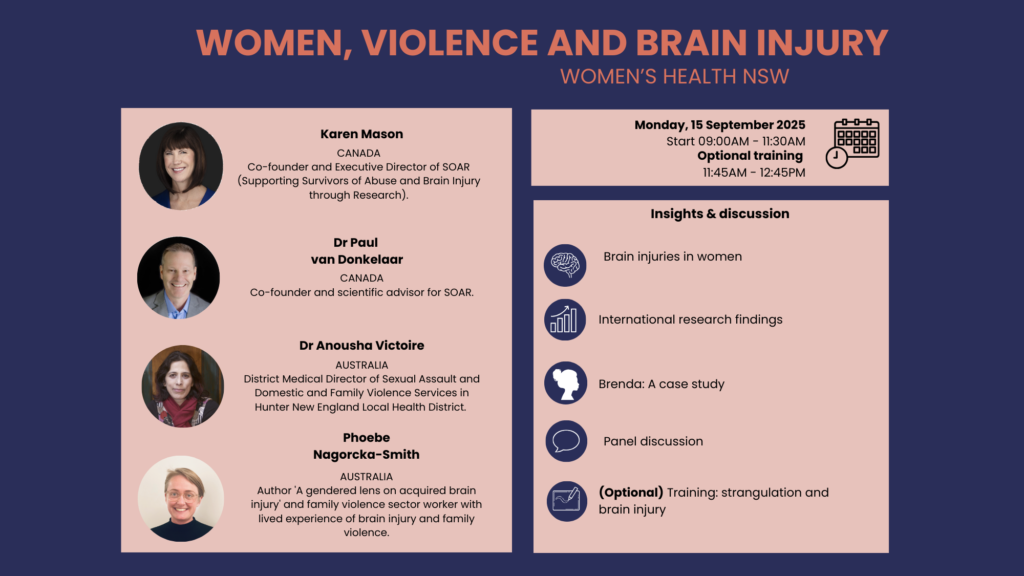
Women’s Health NSW ran an event called Women, Violence and Brain Injury in late 2025. It brought together a range of experts on women’s brain injuries resulting from violence. These short stories are drawn from the presentations of our speakers.
In this short story, Phoebe Nagorcka-Smith points out that we don’t have an accurate national estimate of the number of women who have an acquired brain injury, because they don’t all know they have one yet. This is why it’s important that women are given information about the connection between experiencing domestic, family and sexual violence and brain injury. We have a resource that can help you have that conversation.
In this short story, Dr Anousha Victoire offers advice for GPs who might be working with women who have an acquired brain injury. This includes scheduling regular appointments at the same time every month (brain injuries can make remembering appointments challenging) and picking a time in the day where appointments running over won’t impact other patients (sometimes you need to go slower to accommodate a patient with brain injury).
Getting an assessment for a brain injury can be difficult for women with experiences of violence. In this short story, Phoebe Nagorcka-Smith discusses the case of a women who had experience repeated strangulation struggling to get assessed for brain injury. You can assist women who might have a brain injury from violence by having clear referral pathways at your service. These Guidelines will help you build them.
The impacts of having a brain injury extend beyond the initial injury. In this short story, Phoebe Nagorcka-Smith discusses the longer-term impacts of having a brain injury, including discrimination, social isolation, loss of income and housing instability, which are magnified for women because they are experienced within a broader context of inequality.
Navigating the demands of the justice system can be challenging for all women with experiences of violence, however women with brain injury can find it even tougher. In this short story, Dr Anousha Victoire discusses how brain injuries can impact memory, and that when an older person has a fall, we accept that their story may have slight variations, yet the legal system doesn’t allow women who have brain injury resulting from violence the same consideration.
So what does a person who has a undiagnosed brain injury look like? In this short story, Karen Mason from The SOAR Project draws upon her experiences working in women’s shelters in Canada to unpack some of the behaviours that might clue you in that the woman you’re supporting might have a brain injury caused by intimate partner violence.
And what might a woman with an undiagnosed brain injury tell you about her symptoms? In this short story, Dr Paul van Donkelaar from The SOAR Project in Canada explains some of the symptoms that happen after a brain injury of any sort. When women report these symptoms to us as service providers working in domestic, family and sexual violence, we should be thinking: have I asked her about strangulation or hits and bumps to the head? Is there a mechanism of injury for a brain injury?